
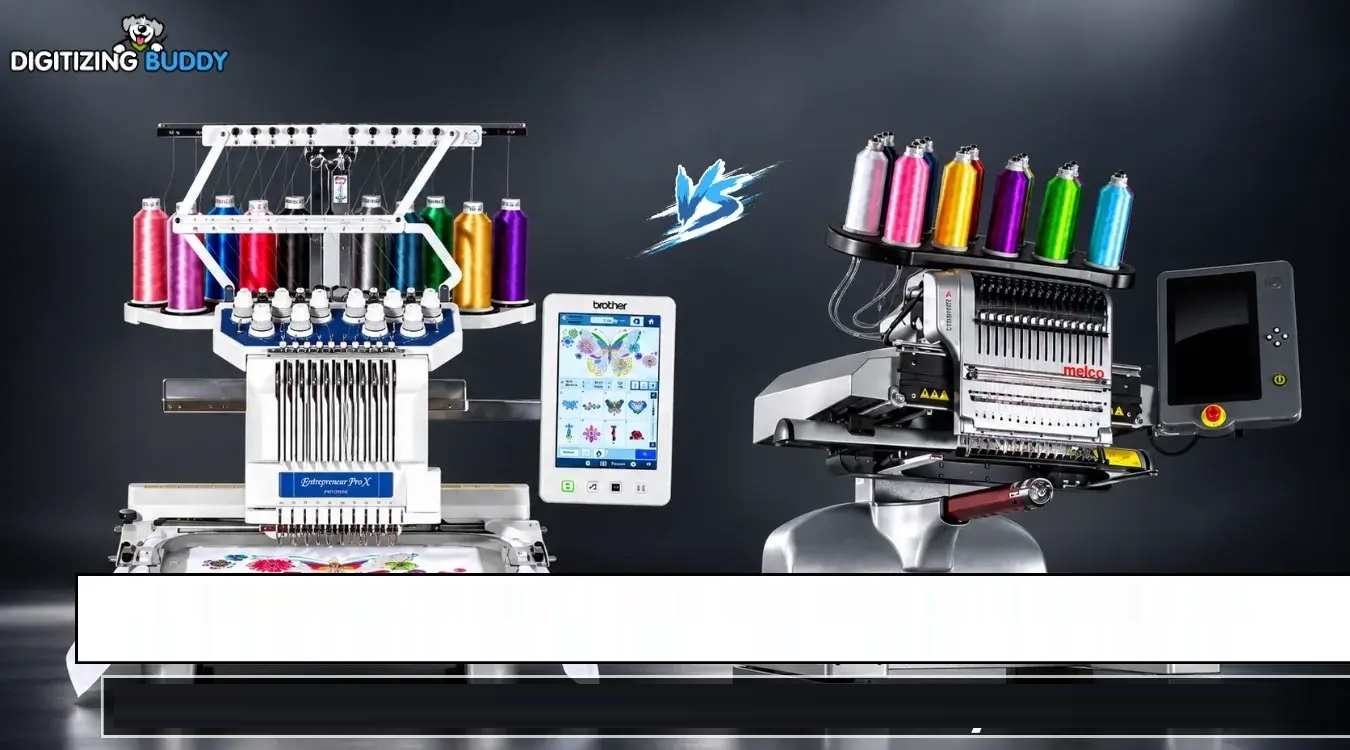
Choosing an embroidery machine is a big decision. The right machine can make production smoother, reduce thread changes, and help you finish customer orders with fewer delays. The wrong fit can leave you paying for features you rarely use.
This Melco and Brother embroidery machine comparison looks at the practical differences between two well-known approaches to commercial and business embroidery. Instead of focusing only on headline specifications, we will look at needle count, embroidery area, speed, automation, workflow, and the type of user each setup may suit.
For a useful reference point, this comparison uses the Melco EMT16X and the Brother PR1060W because both are current commercial-oriented multi-needle machines. Melco lists the EMT16X with 16 needles, a maximum flat speed of 1,500 stitches per minute, and a sewing field of about 16.1 × 15.5 inches. Brother lists the PR1060W with 10 needles, an 8 × 14-inch embroidery area, wireless connectivity, and a built-in camera.
Melco and Brother Embroidery Machine Comparison at a Glance
The two machines take different approaches to embroidery production.
| Feature | Melco EMT16X | Brother PR1060W |
|---|---|---|
| Needle count | 16 | 10 |
| Max flat speed | Up to 1,500 SPM | Up to 1,000 SPM |
| Max embroidery area | About 16.1″ × 15.5″ | 8″ × 14″ |
| Automatic thread control | Acti-Feed automatic tension | Thread sensing and automated functions |
| Positioning | Laser alignment and positioning | Built-in camera and positioning features |
| Connectivity | PC-based workflow and network capability | Wireless and computer connectivity |
| Cap embroidery | Supported | Supported |
| Best fit | Production-focused embroidery | Flexible business and custom embroidery |
Specifications are manufacturer-listed and can vary by configuration, accessories, and operating conditions.
Needle Count and Thread Management
Needle count matters when you frequently embroider multi-color designs.
The Melco EMT16X has 16 needles. That gives an operator more thread choices available at the machine and can reduce the need to stop and manually swap colors during larger designs. Melco also uses its Acti-Feed system for automatic thread control.
The Brother PR1060W provides 10 needles. Brother states that its machine can stitch designs using up to 10 colors without changing thread, while its automatic needle-threading system is designed to make setup easier.
For a shop handling highly colorful logos, patches, or detailed artwork throughout the day, the extra needle positions on the Melco can be useful. For many small-business applications, 10 needles can still cover a wide range of orders.
Why Needle Count Is Important
Think of each needle as a ready-to-use color slot.
The more colors already loaded, the less often you need to stop production. This can be especially helpful when an order includes repeated designs with many thread colors.
Embroidery Speed and Production Capacity
Speed is one of the easiest specifications to compare, but it should not be the only one.
Melco lists the EMT16X at up to 1,500 stitches per minute on flats and up to 1,200 stitches per minute on caps. That gives it a strong production focus, particularly for businesses running longer embroidery jobs.
The Brother PR1060W is listed with a maximum embroidery speed of up to 1,000 stitches per minute. Brother’s documentation also emphasizes rapid acceleration and productivity-focused features.
However, maximum speed does not automatically mean a finished job will take less time. Design complexity, stitch density, thread changes, trimming, fabric type, hooping, and operator experience all affect actual production time.
Embroidery Area and Project Size
If you regularly work on larger jackets, home décor items, or broad designs, embroidery area deserves close attention.
The Melco EMT16X offers a maximum sewing field of about 16.1 × 15.5 inches, depending on the garment and frame setup. It also supports large tubular frames.
The Brother PR1060W provides an 8 × 14-inch maximum embroidery area and includes several frame sizes for different projects. Brother specifically highlights its suitability for larger items such as home décor and jacket backs.
This means your normal product mix should guide the decision. A business mostly creating chest logos and names may not need a very large field. A shop producing oversized designs may benefit from greater working space.
Workflow and Ease of Use
A good embroidery machine should not only stitch well. It should make the entire job easier.
The Melco EMT16X uses a PC-based Melco OS workflow and includes laser positioning, automatic stitch backup, automatic trimming, and thread-break detection. Melco also says up to 30 individual machines can be connected over Ethernet in a modular setup.
The Brother PR1060W takes a more integrated interface approach. It includes a touchscreen, wireless connectivity, built-in camera functionality, on-screen editing, automatic thread cutting, and other workflow tools.
For operators who like a computer-centered production environment, Melco’s system may feel familiar. For users who prefer working directly from a machine touchscreen and using visual positioning tools, Brother offers a highly integrated workflow.
Software and Design Preparation
The machine is only one part of the embroidery process.
Your final stitch quality depends heavily on how the embroidery file is prepared. A logo that looks perfect on a screen may still stitch poorly if it has incorrect density, poor underlay, weak pull compensation, or unsuitable stitch directions.
Melco’s EMT16X brochure states that DesignShop software is included and provides professional digitizing and design tools.
Brother also provides built-in editing tools and design features on the PR1060W, including lettering, automatic density adjustment, drag-and-drop editing, and built-in designs.
This is where professional digitizing can make a noticeable difference. Even a high-quality embroidery machine cannot fully correct a poorly digitized logo.
For businesses that receive artwork from customers, working with Digitizing Buddy can help turn artwork into embroidery-ready files that are better suited to the intended fabric, hoop, and stitch requirements.
Hats, Bags, Jackets, and Difficult Items
Different products create different embroidery challenges.
Caps and small tubular items can be difficult to hoop correctly. Melco highlights its compact lower arm and positioning technology for items with small openings, while the EMT16X supports cap frames and a wide-angle cap option.
The Brother PR1060W also supports cap embroidery and includes a tubular frame table designed to help with garments and larger projects.
Before buying, think about what you actually sell. Embroidering polo shirts all day has different requirements from running a business focused on caps, jackets, patches, bags, and promotional items.
Which Features Matter Most for a Small Embroidery Business?
A common mistake is to compare machines based only on speed.
Instead, look at the full workflow:
- How many color changes do your designs usually require?
- What size are your typical embroidery jobs?
- How often do you embroider caps or tubular products?
- Do you prefer touchscreen control or a PC-centered setup?
- Will your production volume increase soon?
- How important is wireless file transfer?
- How much time do you spend preparing and correcting designs?
For example, a small custom embroidery business producing names, monograms, school items, and simple logos may value ease of setup and built-in editing tools.
A production-oriented shop handling larger orders may place more weight on needle capacity, speed, automation, and scalable machine networking.
Melco and Brother Embroidery Machine Comparison for Beginners
Beginners often assume the machine with more features is automatically the better choice. That is not always true.
A machine with extensive production features can be valuable, but only when those features solve real business problems. An operator who mainly creates small personalized orders may not benefit from every advanced production capability.
Brother’s PR1060W includes built-in designs, fonts, tutorials, touchscreen controls, camera technology, and wireless functionality designed to make operation more approachable.
Melco’s EMT16X is built more heavily around production, computer control, machine networking, and commercial workflow.
That difference is important. Your skill level should be considered alongside your expected order volume.
What About Maintenance and Reliability?
Every embroidery machine needs routine care.
Regular cleaning, correct needle selection, proper hooping, thread quality, bobbin checks, and timely maintenance can all affect embroidery performance.
Melco’s EMT16X includes self-diagnostic capability and automatic stitch backup, while its thread-control system is designed to help maintain consistent embroidery performance.
Brother’s PR1060W includes upper and bobbin thread sensing, automatic cutting, and support resources such as manuals and service information.
The practical lesson is simple: machine maintenance should be part of your production routine, not something you think about only after a problem appears.
How to Choose Between Them
When reviewing this Melco and Brother embroidery machine comparison, focus on your actual workload instead of trying to find one universal winner.
Choose based on measurable business needs such as:
Choose a Production-Focused Setup
A production-focused setup can make sense when you need:
- More needle positions
- Higher listed sewing speed
- Larger sewing fields
- Scalable machine networking
- A computer-centered embroidery workflow
The Melco EMT16X is designed around these types of commercial production requirements.
Choose a Feature-Rich Integrated Workflow
An integrated machine workflow may appeal to users who want:
- A large touchscreen interface
- Wireless connectivity
- Built-in camera positioning
- On-screen editing
- Multiple built-in designs and fonts
- Easy access to guided features
These are among the features Brother lists for the PR1060W.
Tips Before Buying an Embroidery Machine
Before spending money on a commercial embroidery machine, make a simple list of your usual orders.
Write down the most common:
- Design sizes
- Number of thread colors
- Garment types
- Monthly stitch volume
- Cap and tubular projects
- Production deadlines
Then compare those requirements against the machine specifications.
It is also smart to budget for hoops, cap drivers, stabilizers, needles, thread, bobbins, maintenance, software, and professional digitizing. The machine itself is only one part of the total embroidery setup.
The Role of Professional Digitizing
No machine can turn weak artwork into a perfect embroidery file automatically.
Professional digitizing considers stitch type, density, sequence, underlay, pull compensation, satin width, fabric behavior, and other production details. A file optimized for a cap may need different settings from the same logo stitched on a jacket or polo shirt.
That is why machine selection and file preparation should be considered together.
At Digitizing Buddy, professional embroidery digitizing can help prepare artwork for cleaner stitching, better detail, and more reliable production across different embroidery projects.
Final Thoughts on the Melco and Brother Embroidery Machine Comparison
This Melco and Brother embroidery machine comparison shows that the two systems are built around different priorities.
Melco’s EMT16X emphasizes commercial production, 16-needle flexibility, higher listed speed, a large sewing field, automatic thread control, and scalable networking.
Brother’s PR1060W emphasizes a 10-needle workflow with wireless connectivity, camera-based positioning, touchscreen operation, built-in designs, and an 8 × 14-inch embroidery area.
The best choice depends on your projects, production volume, workspace, preferred workflow, and growth plans. Start with the work you actually expect to do, then match the machine to those needs rather than buying features simply because they look impressive on a specification sheet.
FAQs
Is the Melco EMT16X faster than the Brother PR1060W?
Based on the manufacturers’ listed specifications, the Melco EMT16X reaches up to 1,500 stitches per minute on flat work, while the Brother PR1060W is listed at up to 1,000 stitches per minute. Actual production speed depends on the design and material.
How many needles does each machine have?
The Melco EMT16X has 16 needles. The Brother PR1060W has 10 needles. More needles can be useful for designs that require many thread colors.
Which machine has a larger embroidery area?
The Melco EMT16X lists a sewing field of approximately 16.1 × 15.5 inches, while the Brother PR1060W lists a maximum embroidery area of 8 × 14 inches.
Can both machines embroider caps?
Yes. Both systems support cap embroidery, with compatible cap-frame options.
Does a better machine guarantee better embroidery?
No. Machine capability matters, but digitizing quality, thread, needles, stabilizers, hooping, fabric, and machine settings also influence the final result.
Leave a Reply